
Latest Customs Duty Changes in India February 2026. Sector Wise Impact on Renewable Energy, Electronics, Defence, Healthcare & Trade
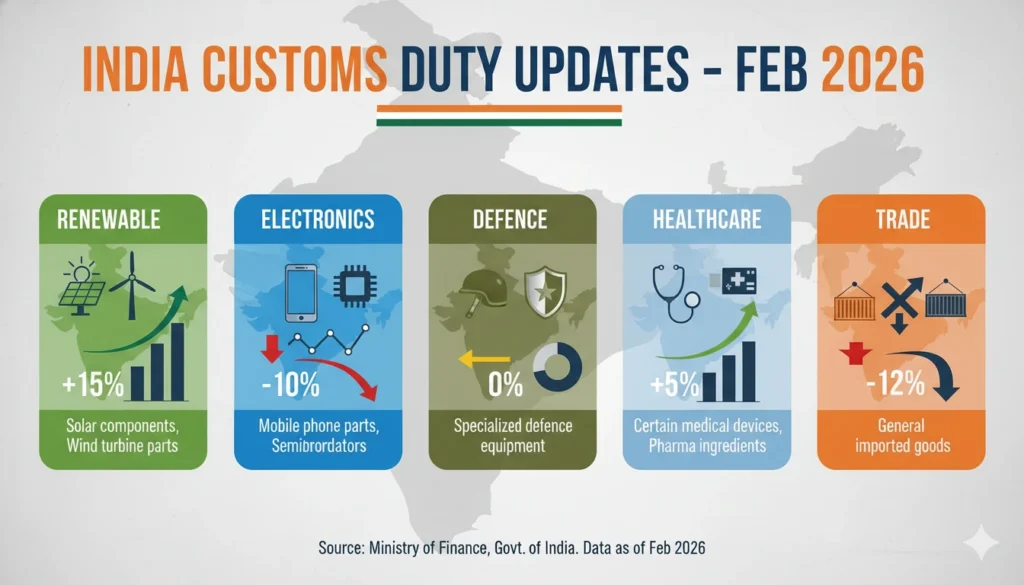
India’s latest customs duty changes in 2026, announced in the Union Budget 2026-27, mark one of the most consequential tariff reforms in recent history. Designed to strengthen domestic manufacturing, spur export growth, improve ease of doing business, and make personal imports more affordable, these changes affect sectors ranging from renewable energy and electronics to defence and healthcare.
In this in depth article, you’ll find,
- a complete sector wise analysis of customs duty updates
- what these changes mean for businesses, traders, manufacturers, and investors
- real market impact and recommended strategies
What Are Customs Duty Changes in India (February 2026)?
The Indian government revised customs duty rates across key categories effective February 2, 2026. These changes reflect a broader strategy to
- reduce cost pressure on strategic sectors
- simplify tariff structures
- support export improvement
- and enhance India’s global trade competitiveness.
The customs duty adjustments cover
- personal imports and travel goods,
- critical minerals and renewable energy inputs
- electronics and IT hardware
- defence and aerospace components
- healthcare and pharmaceuticals
- export facilitation measures
These reforms have immediate implications for importers, exporters, MSMEs, FDI-linked companies, and financial market participants.
1. Customs Duty Reductions on Personal Imports
One of the most attention grabbing changes is the reduction of customs duty on personal imports.
Key Update
The basic customs duty on goods imported for personal use by travellers has been halved from 20% to 10%. This applies to goods such as,
- overseas purchases brought back by travellers,
- online imports via international e-commerce platforms,
- merchandise in excess of duty free baggage allowances.
Why This Matters
This reduction addresses long standing consumer demand for fairer duty on personal imports. It makes popular categories like,
- mobile phones
- electronics accessories
- apparel and lifestyle products
- gadgets and tech gear
more affordable when imported from abroad.
2. Boosting Renewable Energy and Critical Materials
India’s clean energy transition continues to be a priority and customs duty changes reflect strategic support for renewable manufacturing.
Key Revisions
- Critical mineral imports, including monazite, are now duty free.
- Sodium antimonate, used in solar glass and energy systems, now attracts zero duty.
- Capital goods for lithium-ion battery cells and energy storage systems are exempt from duty.
Sector Impact
These measures are designed to support,
- solar power manufacturers
- battery storage firms
- energy systems integrators
- lithium and critical mineral processors.
They reinforce India’s ongoing shift toward renewable energy and clean technology manufacturing.
3. Nuclear Power Project Duty Exemptions
In addition to renewables, nuclear energy infrastructure received tariff support.
Customs Duty Changes
Goods and equipment used for nuclear power generation projects are now exempt from duty,
- until 2035 as part of a long term policy initiative.
Strategic Importance
This reflects India’s plan to bolster base load power capacity while reducing dependence on fossil fuels. Removing tariff barriers lowers overall project costs and improves financial viability.
4. Electronics Manufacturing Lower Costs, Greater Scale
The electronics sector has been a key focus of India’s industrial policy especially under the Production Linked Incentive (PLI) scheme.
Customs Duty Updates
- Components used in electronics manufacturing, especially microwave and assembly components, are now either duty reduced or duty free.
- Special provisions for SEZ (Special Economic Zone) production units allow input import relaxation under possible duty deferral schemes.
Why This is Important
Reducing customs duty on semiconductor and electronic inputs helps,
- increase domestic value addition
- cut production costs
- attract OEMs and global supply chain investors
5. Defence, Aviation and Aerospace Gains
India’s defence and aviation sectors are long in need of a robust local supply chain. Customs duty changes help bridge that gap.
What Changed
Duty exemptions now apply to,
- aircraft manufacturing parts
- repair and maintenance components (MRO)
- specialised defence equipment parts imported by licensed manufacturers.
Industry Impact
- This simplifies import costs for Original Equipment Manufacturers (OEMs).
- Helps local Defence Public Sector Undertakings (DPSUs) expand capabilities.
- Improves India’s standing as a regional MRO hub.
6. Healthcare and Pharmaceutical Imports
Healthcare consumers and medical institutions benefit from targeted duty concessions.
Notable Changes
- Customs duty is waived for 17 cancer medicines and several drugs for rare diseases.
- Essential medical devices and equipment now attract lower duty rates to ease cost pressure.
Public Benefit
This supports patients by lowering treatment costs and encourages hospitals and clinics to invest in advanced diagnostics and treatments.
7. Export & Business Facilitation Measures
In addition to duty cuts, the government also introduced changes to improve competitiveness for exporters.
Key Export Friendly Reforms
- Duty free input entitlements for exporters of seafood, leather and textile products extended.
- Longer export timelines after duty free input imports.
Why It Matters
These reforms aim to,
- make Indian goods more price competitive than abroad
- enhance profitability for exporters
- sustain long term export market share growth.
8. What These Customs Duty Changes Mean for Investors
From a financial markets perspective, customs duty reforms have multi layered impacts
Positive Signals
- Renewable energy and battery stocks may benefit from lower input costs.
- Electronics manufacturing companies could see improved margins.
- Defence and aerospace firms with local production may attract more capital.
Risk Considerations
- Import reliant trading firms may face margin pressure if duties are raised on finished goods in future budgets.
- Global commodity price volatility can still influence net landed costs.
Best Practice for Investors
Use customs duty trends as part of,
- sector forecasting
- sensitivity analysis
- Risk adjusted portfolio planning.
Conclusion
India’s customs duty changes for February 2026 signal a shift toward,
- tariff simplification
- Industry friendly policy
- export ecosystem support
- consumer relief.
These reforms will resonate across economic sectors and are expected to influence,
- business competitiveness
- capital inflows
- manufacturing expansion
- and trade dynamics
Explore our multiple Finance Services
-
Business Loan
-
MSME Loan
-
Home Loan
-
Loan against Property
-
Project Finance
-
Doctor Loan
-
Medical Equipment Loan
-
Working Capital Loan
-
Industrial Equipment Loan
-
Supply Chain Finance
-
Corporate Loan
-
Commercial Vehicle Loan
-
Construction Equipment Loan
-
Real Estate Project Finance
-
Loan for Schools & Colleges
FAQ’s
1. What are the major highlights of Union Budget 2026-27?
Union Budget 2026–27 focuses on infrastructure-led growth, manufacturing competitiveness, tax and customs simplification, support for strategic sectors, and ease of doing business while continuing fiscal consolidation.
2. Were there any major changes in income tax slabs in Budget 2026?
No major changes were made to basic income tax slabs. However, the government emphasized simplification of income tax laws and improved compliance under the revamped Income Tax framework effective from April 2026.
3. What changes were introduced in customs duty in Budget 2026?
Budget 2026 introduced rationalisation of customs duties, reduced duties on critical inputs, exemptions for strategic sectors like renewable energy, electronics, defence, and healthcare, and measures to correct inverted duty structures.
4. How does Budget 2026 support manufacturing and Make in India?
The budget supports manufacturing through lower input costs, targeted customs duty exemptions, incentives for advanced manufacturing, expansion of PLI-linked ecosystems and improved trade facilitation measures.
5. What are the key benefits for the renewable energy sector in Budget 2026?
Renewable energy benefits include customs duty relief on capital goods, components for solar, wind, battery energy storage systems and green technologies, aimed at reducing project costs and accelerating clean energy adoption.
6. How does Budget 2026 impact the electronics industry?
The electronics sector gains from duty exemptions on components and critical minerals, reduced dependency on imports for finished goods, and improved cost competitiveness for domestic manufacturing.
7. What changes were announced for the defence and aerospace sectors?
Customs duty exemptions on raw materials, aircraft parts, and MRO components were introduced to strengthen defence indigenisation, reduce maintenance costs, and promote India as an aerospace manufacturing and MRO hub.
8. How does Budget 2026 benefit the healthcare and pharmaceutical sectors?
The budget provides customs duty exemptions on selected life saving drugs, medical equipment, and pharmaceutical inputs, helping reduce treatment costs and improve access to advanced healthcare.
9. What measures in Budget 2026 support MSMEs and small businesses?
MSMEs benefit from improved access to credit, simplified tax and customs procedures, reduced compliance burden, and lower input costs through duty rationalisation.
10. How does Budget 2026 promote exports and trade competitiveness?
By lowering input duties, simplifying tariff structures, improving logistics infrastructure, and enhancing trade facilitation, Budget 2026 aims to boost India’s export competitiveness globally.
11. Were there any changes related to capital expenditure in Budget 2026?
Yes. Budget 2026 continued a strong focus on capital expenditure, particularly in infrastructure, logistics, transport, energy, and industrial corridors to stimulate long-term economic growth.
12. How does Budget 2026 improve ease of doing business?
The budget focuses on tax law simplification, customs automation, faster clearances, reduced litigation, and predictable policy measures to improve business confidence.
13. What is the impact of Budget 2026 on foreign investors?
Foreign investors benefit from policy stability, rationalised tax and duty structures, incentives for manufacturing and digital infrastructure, and improved supply-chain resilience.
14. When do the Budget 2026 changes come into effect?
Most tax and customs changes announced in Budget 2026 come into effect from February 2026 or April 1, 2026, subject to official notifications.
15. Who benefits the most from Budget 2026?
Manufacturers, exporters, MSMEs, renewable energy companies, electronics producers, healthcare providers, and infrastructure linked industries are among the key beneficiaries.